Introduction
Accurate assessment of cardiac health hinges on understanding the normal EKG axis, a critical factor for clinicians in identifying potential abnormalities. Clinicians often face difficulties in accurately interpreting EKG results, which can lead to misdiagnosis. This article explores standard methods for determining the normal EKG axis and the clinical implications of deviations.
As technology advances, the question arises: how can healthcare professionals use AI-driven tools like those from Neural Cloud Solutions Inc. and MaxYield to boost their diagnostic accuracy and enhance patient care? By utilizing these advanced solutions, healthcare professionals can significantly enhance their diagnostic capabilities and improve patient outcomes.
Define the Normal EKG Axis and Its Importance
Understanding the normal ekg axis orientation is essential for clinicians to accurately assess heart health. The standard EKG orientation indicates the overall direction of the heart's electrical activity during depolarization, which is typically aligned with the normal ekg axis and measured in degrees using a hexaxial reference system. In adults, the normal EKG axis for QRS orientation ranges from -30° to +90°. This knowledge helps clinicians assess the heart's electrical orientation and identify potential abnormalities in relation to the normal ekg axis. A typical orientation suggests that the heart's electrical signals are transmitting properly, reflecting a normal ekg axis, while variations can indicate different cardiac issues, such as hypertrophy or conduction blocks. For instance, left lateral shift (LAD) or right lateral shift (RAD) may indicate underlying conditions that require additional examination.
Recent research emphasizes the clinical significance of alignment variations. For example, left ventricular misalignment has been linked to a notably increased risk of major adverse cardiovascular events (MACE), with a cumulative 3-year incidence of 26.4% in those affected. This necessitates a more vigilant approach to patient assessment and management. Monitoring alignment discrepancies can be challenging but is essential for improving patient outcomes. Moreover, the normal ekg axis serves as an essential indicator for evaluating cardiovascular risk, especially in groups with hypertension, where variations can suggest more serious underlying issues.
In Canada, comprehending the typical EKG orientation is crucial for enhancing outcomes for individuals. The incorporation of sophisticated ECG analysis technologies, like those provided by Neural Cloud Solutions, improves the precision of identifying deviations in orientation, thus assisting healthcare professionals in making informed clinical decisions. Understanding the normal ekg axis is key for accurate ECG analysis and better patient care.

Determine the Normal EKG Axis Using Standard Methods
Determining the normal ekg axis can be challenging for clinicians, especially when they rely on traditional methods. To enhance diagnostic accuracy, particularly when integrated with MaxYield™, Neural Cloud Solutions Inc.'s transformative ECG analysis solution, clinicians can utilize several standard methods that improve ECG analysis:
- Hexaxial Reference System: This method involves plotting the QRS complexes from leads I and aVF on a hexaxial diagram. If both leads are positive, the orientation lies between 0° and +90°, indicating a normal orientation. Conversely, if lead I is positive and lead aVF is negative, the direction suggests left axis deviation, which lies between 0° and -90°. With MaxYield™, this process becomes automated, making assessments quicker and more accurate.
- Lead Analysis: Identify the lead with the tallest QRS complex, as this lead indicates the direction of the orientation. For example, if lead II shows the tallest QRS, the direction is towards lead II, indicating a normal or leftward orientation. MaxYield™ enhances this analysis by offering AI-driven insights that rival human interpretation, ensuring accuracy in determining the direction.
- Isoelectric Lead Method: This technique involves locating the isoelectric lead, where the QRS complex is closest to zero. The line is perpendicular to this lead; for instance, if lead III is isoelectric, the line will be positioned at either 90° or 270°. MaxYield™'s adaptability allows it to seamlessly integrate with existing workflows, making this method more efficient.
- Graphical Method: Calculate the net amplitude of the QRS complexes in the limb leads and plot these values on a graph to determine the angle accurately. MaxYield™ provides a device-agnostic ECG intelligence layer that can enhance graphical analysis without requiring hardware changes.
These methods provide a reliable way to evaluate the normal ekg axis, which is crucial for accurate diagnosis and treatment planning. Notably, the hexaxial reference system is widely used in Canada, with studies indicating its effectiveness in clinical settings. By leveraging MaxYield™, healthcare professionals can streamline their ECG analysis, leading to improved patient outcomes. Expert endorsements from Dr. Alan Rabinowitz, Dr. Brett Heilbron, and Dr. Marc W. Deyell emphasize MaxYield’s precision and noise reduction benefits. Additionally, Insight360 complements MaxYield™ by transforming clean ECG data into interactive dashboards and clinical-ready reports, further enhancing the analysis process.

Identify and Interpret Deviations from the Normal EKG Axis
Variations in EKG orientation can reveal crucial insights into cardiac health, yet traditional analysis methods often fall short in efficiency. With the incorporation of Neural Cloud Solutions Inc.'s MaxYield™, these insights can be obtained with improved accuracy. Here are the primary deviations:
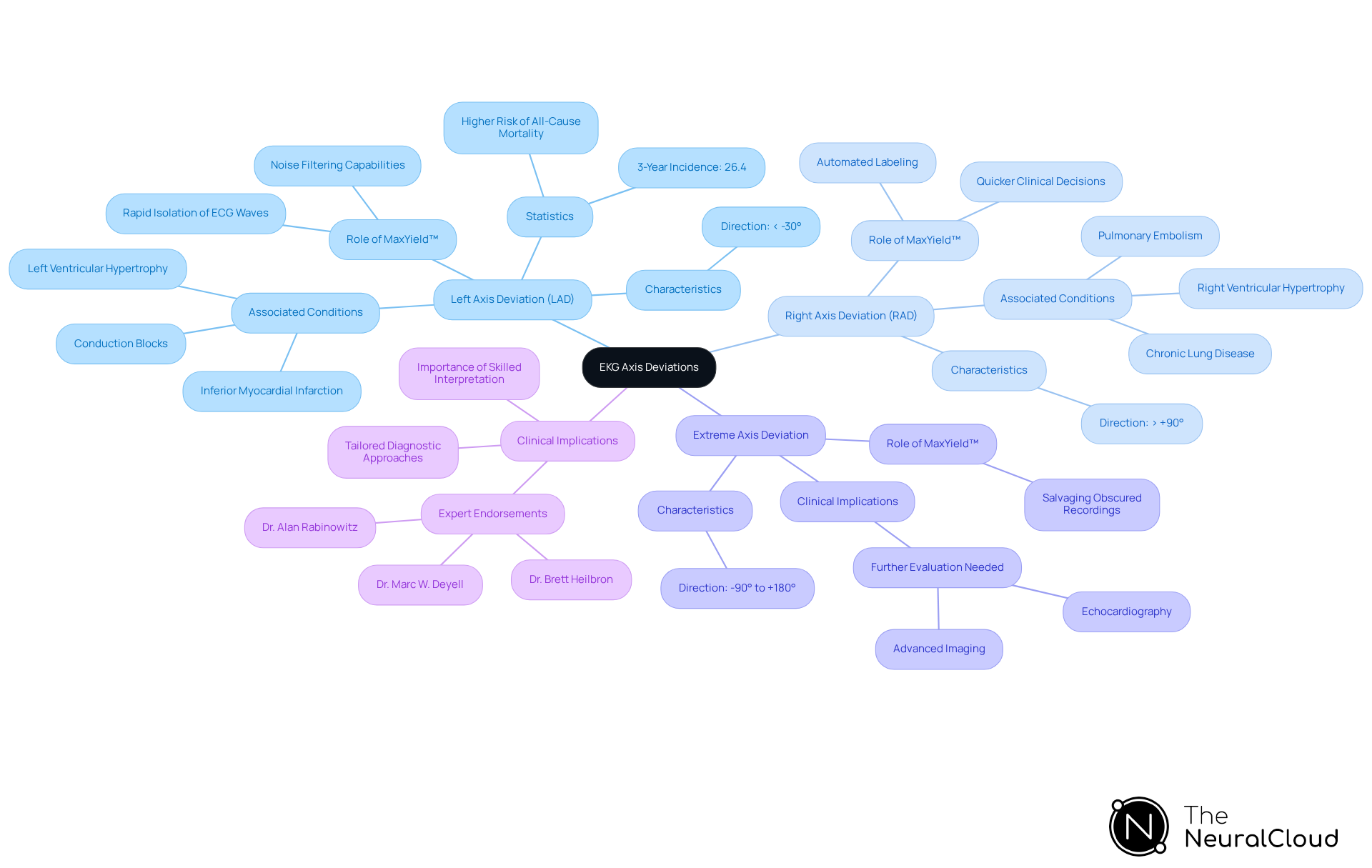
- Left Axis Deviation (LAD): Characterized as a direction less than -30°, LAD can suggest conditions such as left ventricular hypertrophy, inferior myocardial infarction, or conduction blocks. A study with 3,353 individuals found that a left orientation shift is associated with a higher risk of all-cause mortality and major cardiovascular incidents. The cumulative 3-year incidence of these outcomes was 26.4% for the left deviation group, compared to 22.7% for the right deviation and 18.4% for the groups with a normal ekg axis. Clinicians should assess the patient's history and symptoms to determine the clinical significance of LAD. With MaxYield's advanced noise filtering capabilities, clinicians can rapidly isolate ECG waves from recordings that may have been previously obscured by noise and artifacts, ensuring that critical data is not overlooked.
- Right Axis Deviation (RAD): A direction greater than +90° indicates right ventricular hypertrophy, pulmonary embolism, or chronic lung disease. It is essential to correlate RAD with clinical findings and other diagnostic tests. MaxYield™ enhances this process by providing automated labeling, which reduces the time spent on manual interpretation and allows for quicker clinical decisions.
- Extreme Axis Deviation: This occurs when the axis is between -90° and +180°, often indicating severe underlying pathology. Clinicians should consider further evaluation, including echocardiography or advanced imaging. MaxYield™ can be invaluable in these cases by salvaging sections of lengthy Holter, 1-Lead, and patch monitor recordings that were previously obscured.
- Clinical Implications: Understanding these variations, such as the normal ekg axis, helps healthcare providers tailor their diagnostic approaches and treatment plans. For instance, identifying RAD in an individual with chest pain may prompt immediate intervention for potential pulmonary embolism. Furthermore, the occurrence of leftward shifts in Canadian cardiac individuals highlights the necessity for healthcare professionals to be skilled at interpreting these shifts to enhance diagnostic precision and improve outcomes for those receiving care. Expert endorsements from Dr. Alan Rabinowitz, Dr. Brett Heilbron, and Dr. Marc W. Deyell emphasize that MaxYield™ rivals human interpretation in precision and significantly reduces noise, further supporting clinicians in their diagnostic efforts.
By mastering the interpretation of axis variations, clinicians can enhance their diagnostic precision and improve outcomes for individuals, leveraging the capabilities of MaxYield™ to address challenges in ECG analysis effectively.
Leverage AI Technologies for Enhanced EKG Analysis
Despite advancements in technology, EKG analysis still faces significant challenges that can impact patient outcomes. Artificial Intelligence (AI) is fundamentally transforming EKG analysis by significantly enhancing both accuracy and efficiency through several key advancements:
- Automated Interpretation: AI algorithms quickly analyze EKG data, making it easier to spot patterns and deviations that might be missed by human eyes. This ability speeds up diagnosis and treatment decisions, leading to better outcomes for patients.
- Noise Reduction: Advanced AI techniques filter out noise and artifacts from EKG signals, improving data quality. This is particularly advantageous in high-interference environments, such as emergency settings, where clarity is crucial for accurate assessments.
- Predictive Analytics: By examining historical EKG data, AI can anticipate future cardiac events, facilitating proactive management of individuals. For instance, machine learning models can identify individuals at risk for arrhythmias based on their unique EKG patterns, allowing for timely interventions.
- Integration with Existing Systems: AI technologies can be seamlessly integrated into current EKG systems, such as MaxYield, augmenting their capabilities without necessitating extensive hardware modifications. This integration enables real-time analysis and visualization of EKG data, streamlining workflow efficiency.
- Clinical Decision Support: AI gives clinicians decision support tools that can suggest possible diagnoses based on EKG findings. This guidance assists in developing treatment plans, thereby improving care for individuals.
Recent studies indicate that AI-enhanced EKG analysis can significantly improve diagnostic accuracy. For instance, a deep neural network (DNN) model demonstrated an overall accuracy of 85.7% in diagnosing left ventricular systolic dysfunction (LVSD), showcasing the potential of AI to refine clinical assessments. Furthermore, AI technologies have been shown to reduce false positive activation rates in emergency settings, enhancing the reliability of EKG interpretations.
By embracing AI technologies, healthcare professionals can not only enhance their diagnostic capabilities but also ensure better patient outcomes.

Conclusion
Understanding the normal EKG axis is essential for clinicians seeking to improve diagnostic accuracy and patient outcomes. By grasping the standard orientation of the heart's electrical activity, healthcare professionals can better identify potential abnormalities that may indicate serious cardiac conditions. The normal EKG axis, typically ranging from -30° to +90°, serves as a foundational element in assessing heart health and guiding clinical decisions.
In this tutorial, we’ve explored different methods to determine the normal EKG axis, including the hexaxial reference system, lead analysis, isoelectric lead method, and graphical method. Each technique offers unique advantages, especially when integrated with advanced solutions like MaxYield™ from Neural Cloud Solutions Inc., which automates and enhances the analysis process. Additionally, recognizing deviations such as left axis deviation (LAD) and right axis deviation (RAD) is crucial for tailoring treatment plans and improving patient care.
Integrating AI technologies into EKG analysis marks a significant advancement. It provides clinicians with tools that enhance diagnostic precision and efficiency. By leveraging AI for automated interpretation, noise reduction, and predictive analytics, healthcare professionals can make informed decisions that lead to better patient outcomes. Embracing these innovations not only streamlines workflows but also empowers clinicians to effectively address the complexities of cardiac monitoring. As cardiology evolves, the ability to interpret the normal EKG axis will be crucial for healthcare providers committed to exceptional patient care.
Frequently Asked Questions
What is the normal EKG axis and why is it important?
The normal EKG axis indicates the overall direction of the heart's electrical activity during depolarization, typically ranging from -30° to +90° in adults. It is crucial for clinicians to assess heart health and identify potential abnormalities.
How is the normal EKG axis measured?
The normal EKG axis is measured in degrees using a hexaxial reference system, which helps clinicians evaluate the heart's electrical orientation.
What does a typical EKG axis orientation suggest?
A typical EKG axis orientation suggests that the heart's electrical signals are transmitting properly, reflecting normal heart function.
What variations in the EKG axis can indicate cardiac issues?
Variations such as left lateral shift (LAD) or right lateral shift (RAD) can indicate underlying cardiac conditions that may require further examination.
What is the clinical significance of alignment variations in the EKG axis?
Alignment variations, such as left ventricular misalignment, have been linked to an increased risk of major adverse cardiovascular events (MACE), necessitating vigilant patient assessment and management.
How does the normal EKG axis relate to cardiovascular risk?
The normal EKG axis serves as an essential indicator for evaluating cardiovascular risk, particularly in individuals with hypertension, where variations may suggest more serious underlying issues.
How can advanced ECG analysis technologies assist in EKG axis evaluation?
Advanced ECG analysis technologies, like those provided by Neural Cloud Solutions Inc., enhance the precision of identifying deviations in EKG axis orientation, aiding healthcare professionals in making informed clinical decisions.
List of Sources
- Define the Normal EKG Axis and Its Importance
- Clinical impact of left and right axis deviations with narrow QRS complex on 3-year outcomes in a hospital-based population in Japan - Scientific Reports (https://nature.com/articles/s41598-021-88259-8)
- theneuralcloud.com (https://theneuralcloud.com/post/master-cardiac-axis-interpretation-with-advanced-ecg-techniques)
- EKG- Disorders of Axis (https://cancertherapyadvisor.com/home/decision-support-in-medicine/hospital-medicine/ekg-disorders-of-axis)
- Electrical Right and Left Axis Deviation - StatPearls - NCBI Bookshelf (https://ncbi.nlm.nih.gov/books/NBK470532)
- Determine the Normal EKG Axis Using Standard Methods
- theneuralcloud.com (https://theneuralcloud.com/post/master-cardiac-axis-interpretation-with-advanced-ecg-techniques)
- ECG Axis Interpretation (https://litfl.com/ecg-axis-interpretation)
- Determining Axis (https://healio.com/cardiology/learn-the-heart/ecg-review/ecg-interpretation-tutorial/determining-axis)
- Identify and Interpret Deviations from the Normal EKG Axis
- Right Axis Deviation (RAD) (https://litfl.com/right-axis-deviation-rad-ecg-library)
- Clinical impact of left and right axis deviations with narrow QRS complex on 3-year outcomes in a hospital-based population in Japan - Scientific Reports (https://nature.com/articles/s41598-021-88259-8)
- Electrical Right and Left Axis Deviation - StatPearls - NCBI Bookshelf (https://ncbi.nlm.nih.gov/books/NBK470532)
- Clinical impact of left and right axis deviations with narrow QRS complex on 3-year outcomes in a hospital-based population in Japan - PMC (https://pmc.ncbi.nlm.nih.gov/articles/PMC8076182)
- Leverage AI Technologies for Enhanced EKG Analysis
- Spotlight on early detection of 3 heart diseases using ECG-AI - Mayo Clinic News Network (https://newsnetwork.mayoclinic.org/discussion/spotlight-on-early-detection-of-3-heart-diseases-using-ecg-ai)
- AI and ECG Interpretation: Insights and Trends for Cardiologists (https://gehealthcare.com/en/insights/article/ai-and-ecg-interpretation-insights-and-trends-for-todays-cardiologists?srsltid=AfmBOoqTQkCtqr7P-3OTQTs06RDxs6q1V5yBouQ0PPb8H7bE3AEUrotV)
- AI-Based ECG Analysis Significantly Improves STEMI Detection, Reduces False Activations - American College of Cardiology (https://acc.org/latest-in-cardiology/articles/2025/10/24/16/56/tues-554pm-ai-tct-2025)
- With AI, researchers discover new way to detect sudden cardiac death risk - Berkeley News (https://news.berkeley.edu/2026/06/24/with-ai-researchers-discover-new-way-to-detect-sudden-cardiac-death-risk)