Introduction
As cardiac monitoring technology advances, healthcare professionals must weigh the benefits and drawbacks of 1-lead versus 6-lead ECG systems. Each option presents unique advantages and challenges that can significantly impact patient outcomes and diagnostic accuracy. As clinicians and researchers in Canada navigate this decision, understanding the core differences in performance, usability, and integration becomes essential. The choice between these systems could be pivotal in shaping the future of patient care and diagnostic precision.
Define 1-Lead and 6-Lead ECG Systems
Traditional ECG setups often struggle with limited data accuracy, which can hinder effective cardiac monitoring. The comparison of 1-lead vs. 6-lead ECG setups shows that:
-
A 1-lead ECG captures the heart's electrical activity using a single electrode, typically involving two electrodes placed on the body.
- Its simple design makes it portable and easy to use, perfect for personal health monitoring.
-
In contrast, the 1-lead vs. 6-lead ECG arrangement employs six electrodes to offer a more thorough view of the heart's electrical activity, enabling data collection from various angles.
- This setup enhances diagnostic capabilities by allowing for a more detailed analysis of heart activity, facilitating better detection of arrhythmias and other cardiac conditions.
- The six-lead setup is often found in advanced medical devices, giving a richer dataset for analysis, which is crucial for effective patient management.

Compare Performance Metrics: Accuracy and Signal Clarity
In the realm of ECG analysis, the choice between 1-lead vs. 6-lead ECG systems presents significant challenges for healthcare professionals. Recent studies indicate that when comparing 1-lead vs. 6-lead ECG, the six-lead ECGs show improved sensitivity and specificity in identifying arrhythmias, particularly atrial fibrillation, compared to single-lead systems. For example, a 6-lead ECG achieves sensitivity rates of up to 99.8%. Its specificity rates are around 97%, making it a reliable choice for clinical applications. In contrast, while 1-lead vs. 6-lead ECGs indicate that single-lead ECGs are effective for basic monitoring, they often struggle with noise interference and may miss subtle arrhythmias due to limited data capture. Choosing the right ECG device can be challenging due to varying performance metrics, especially in Canada, where regulatory compliance, such as FDA Class II SaMD clearance-pending status, is crucial.
Neural Cloud Solutions' MaxYield™ platform addresses these challenges by employing advanced noise filtering and distinct wave recognition capabilities. With MaxYield™, lengthy and noisy ECG recordings become clean and crisp signals, significantly enhancing the efficiency of ECG analysis. Expert endorsements from Dr. Alan Rabinowitz, Dr. Brett Heilbron, and Dr. Marc W. Deyell highlight that MaxYield™ rivals human interpretation in precision and offers substantial noise reduction benefits. This innovative approach not only enhances diagnostic accuracy but also simplifies the workflow for healthcare professionals, making it an invaluable tool for health tech developers and clinicians alike. With MaxYield™, healthcare professionals can confidently rely on precise ECG analysis, ultimately improving patient outcomes.

Evaluate Usability: Integration and User Experience
When it comes to ECG devices, usability plays a pivotal role in their effectiveness and adoption. When considering the 1-lead vs. 6-lead ECG, the 1-lead ECG is often preferred for its simplicity and user-friendly design, making it particularly suitable for personal health monitoring and rapid assessments. Its compact form facilitates seamless integration into mobile health applications, allowing users to perform ECG tests with minimal setup. In contrast, the six-lead ECG setup, while more complex, provides enhanced diagnostic abilities that can be efficiently integrated into clinical workflows. This complexity can lead to challenges in effective utilization without proper training, especially in environments where detailed analysis is required.
Users often find that their experiences can vary quite a bit when comparing 1-lead vs. 6-lead ECG devices. While 1-lead vs. 6-lead ECG configurations offer a straightforward method, the six-lead setups produce a more extensive dataset, requiring enhanced technical knowledge and operational skill from users. In Canada, research shows that single-lead ECG devices are gaining traction in mobile health applications, with healthcare professionals acknowledging their potential for improving patient engagement and monitoring efficiency. This highlights the need for a balanced approach in choosing ECG devices based on the clinical context, especially in intricate diagnostic situations.
'Neural Cloud Solutions Inc.'s MaxYield™ platform further enhances the usability of both frameworks by employing advanced noise filtering and distinct wave recognition. This technology allows for the rapid isolation of ECG waves from recordings with baseline wander, movement, and muscle artifact, significantly improving the accuracy and efficiency of ECG analysis. Expert endorsements from Dr. Alan Rabinowitz, Dr. Brett Heilbron, and Dr. Marc W. Deyell emphasize that MaxYield™ rivals human interpretation in precision and offers substantial noise reduction benefits.
Case studies from Canadian healthcare environments show that the incorporation of 1-lead vs. 6-lead ECG devices into mobile applications has enhanced accessibility for patients, enabling prompt monitoring of cardiac health. However, the functionality of six-lead configurations remains essential in settings where thorough examination is necessary, highlighting the significance of balancing user-friendliness with diagnostic thoroughness in the changing realm of cardiac treatment.
Addressing these challenges is essential for maximizing the potential of ECG technology in patient care. Additionally, it is important to note that MaxYield™ is currently pending FDA Class II SaMD clearance, ensuring compliance with regulatory standards.

Summarize Pros and Cons of 1-Lead vs. 6-Lead ECG
Choosing the right ECG system is crucial for effective cardiac monitoring and diagnosis. The comparison of 1-lead vs. 6-lead ECG systems reveals distinct benefits and drawbacks that affect their use in clinical environments.
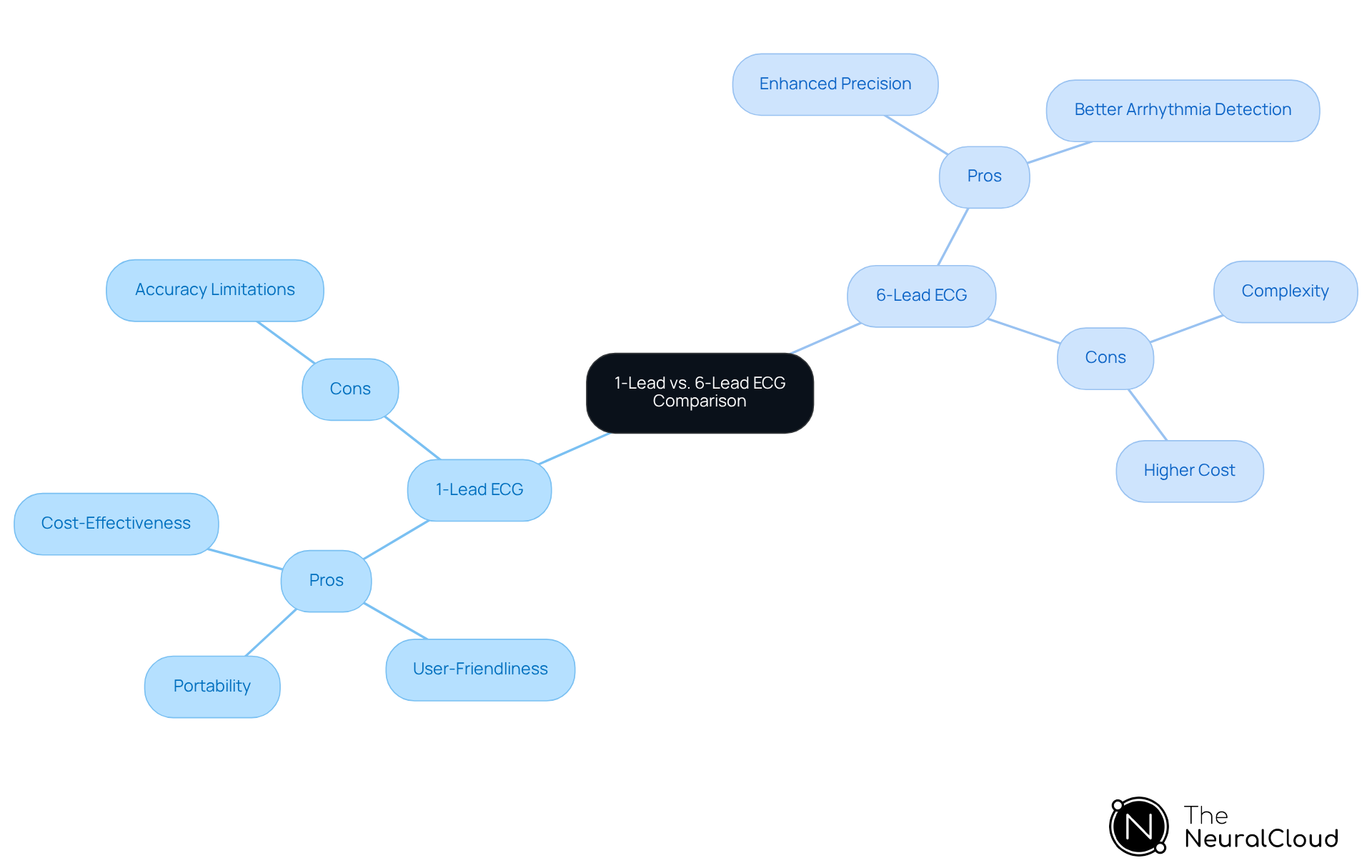
- The 1-lead ECG is celebrated for its portability, user-friendliness, and cost-effectiveness, making it an ideal choice for personal monitoring and basic assessments.
- While the 1-lead ECG is portable and user-friendly, its accuracy limitations can hinder effective diagnosis in complex cases.
- In contrast, the six-lead ECG provides enhanced precision, allowing healthcare providers to diagnose complex arrhythmias more effectively.
- However, the intricacy and increased expense of six-lead configurations may discourage certain users, especially in resource-limited settings.
In Canada, healthcare providers are focusing on optimizing diagnostic workflows, so the choice between these ECG systems should consider the specific clinical context and user needs. Case studies indicate that while the 1-lead vs. 6-lead ECG systems are effective for routine monitoring, 6-lead systems significantly enhance the detection of arrhythmias, thereby improving patient outcomes. Ultimately, aligning the choice of ECG system with clinical needs can lead to better patient care and outcomes.
Conclusion
The differences between 1-lead and 6-lead ECG systems are crucial for effective cardiac monitoring. While the 1-lead ECG offers simplicity and portability, making it suitable for personal health monitoring, the 6-lead ECG provides a comprehensive view of cardiac activity, essential for accurate diagnosis and management of complex arrhythmias. Healthcare professionals must recognize these differences to select the most appropriate technology for their clinical needs.
Key insights from the article reveal that the 6-lead ECG significantly outperforms its 1-lead counterpart in terms of sensitivity and specificity, particularly in detecting conditions like atrial fibrillation. The usability of each system varies:
- The 1-lead ECG is more user-friendly for quick assessments,
- The 6-lead ECG requires more technical knowledge but delivers richer data for thorough analysis.
The integration of advanced technologies, such as Neural Cloud Solutions Inc.'s MaxYield™, further enhances the effectiveness of both systems, ensuring high-quality ECG analysis and improved patient outcomes.
Ultimately, healthcare professionals should carefully evaluate the clinical context and patient needs when choosing between 1-lead and 6-lead ECG systems. As the landscape of cardiac monitoring evolves, embracing the right technology can lead to enhanced diagnostic capabilities and better patient care. Choosing the right ECG technology can significantly impact patient outcomes and the quality of care provided.
Frequently Asked Questions
What is a 1-lead ECG system?
A 1-lead ECG system captures the heart's electrical activity using a single electrode, typically involving two electrodes placed on the body. Its simple design makes it portable and easy to use, making it suitable for personal health monitoring.
What is a 6-lead ECG system?
A 6-lead ECG system employs six electrodes to provide a more comprehensive view of the heart's electrical activity. This setup allows for data collection from various angles, enhancing diagnostic capabilities and facilitating better detection of arrhythmias and other cardiac conditions.
How do 1-lead and 6-lead ECG systems compare in terms of data accuracy?
Traditional 1-lead ECG setups often struggle with limited data accuracy, which can hinder effective cardiac monitoring. In contrast, the 6-lead ECG setup offers a richer dataset for analysis, crucial for effective patient management and more detailed analysis of heart activity.
Where are 6-lead ECG systems typically used?
The 6-lead ECG setup is often found in advanced medical devices, providing enhanced diagnostic capabilities for clinicians and researchers in the field of cardiac health.
List of Sources
- Define 1-Lead and 6-Lead ECG Systems
- Single-Lead ECG Machines Market Forecast to 2033 (https://persistencemarketresearch.com/market-research/single-lead-ecg-machines-market.asp)
- Resources | AliveCor (https://alivecor.com/biopharma/resources/breakthrough-jama-study-kardiamobile-6l-device-rivals-traditional-12-lead-in-efficiency-and-effectiveness)
- Single Lead Electrocardiogram (ECG) Equipment Market Size, Trends, Growth Report 2033 (https://databridgemarketresearch.com/reports/global-single-lead-ecg-equipment-market?srsltid=AfmBOoqoTaZpFDHyQnbfkGELvsZBRF5J8cSx8LyJ2lPs7FMyQHZs5dVT)
- Single-Lead ECG Monitor Market Size & Growth Statistics 2034 (https://factmr.com/report/single-lead-ecg-monitor-market)
- Kardia’s 6-Lead ECG Detects More Arrhythmia Events than Guideline-Recommended Devices | HCPLive (https://hcplive.com/view/kardia-s-6-lead-ecg-detects-more-arrhythmia-events-than-guideline-recommended-devices)
- Compare Performance Metrics: Accuracy and Signal Clarity
- Resources | AliveCor (https://alivecor.com/biopharma/resources/breakthrough-jama-study-kardiamobile-6l-device-rivals-traditional-12-lead-in-efficiency-and-effectiveness)
- Six-Lead ECG Device Highly Accurate for Atrial Fibrillation Detection (https://thecardiologyadvisor.com/news/6-lead-ecg-device-highly-accurate-for-atrial-fibrillation-detection)
- Kardia’s 6-Lead ECG Detects More Arrhythmia Events than Guideline-Recommended Devices | HCPLive (https://hcplive.com/view/kardia-s-6-lead-ecg-detects-more-arrhythmia-events-than-guideline-recommended-devices)
- Comparative Analysis of 6-Lead and Single Lead Consumer-Grade Electrocardiograms: Diagnostic Accuracy, Numerical Agreement, and Inter-Rater Reliability - VUNO, View the Invisible, Know the Unknown (https://vuno.co/en/publication/view/3176)
- KardiaMobile 6L is Superior to One Lead Personal Devices (https://prnewswire.com/news-releases/kardiamobile-6l-is-superior-to-one-lead-personal-devices-301367374.html)
- Evaluate Usability: Integration and User Experience
- U.S. Smart Wearable ECG Monitors Market Size Report 2030 (https://grandviewresearch.com/industry-analysis/us-smart-wearable-ecg-monitors-market-report)
- Mobile ECG Devices Market Size, Share & 2031 Growth Trends Report (https://mordorintelligence.com/industry-reports/mobile-ecg-devices-market)
- Remote and Wearable ECG Devices with Diagnostic Abilities in Adults: A State-of-the-Science Scoping Review - PMC (https://pmc.ncbi.nlm.nih.gov/articles/PMC9250606)
- Resources | AliveCor (https://alivecor.com/biopharma/resources/breakthrough-jama-study-kardiamobile-6l-device-rivals-traditional-12-lead-in-efficiency-and-effectiveness)
- ECG Workflow Challenges in Cardiology (https://scimage.com/ecg-workflow-challenges-in-cardiology)
- Summarize Pros and Cons of 1-Lead vs. 6-Lead ECG
- Single-Lead ECG Monitor Market Size & Growth Statistics 2034 (https://factmr.com/report/single-lead-ecg-monitor-market)
- Study Shows 6-lead Personal ECG Device Significantly Increases Arrhythmia Detection (https://dicardiology.com/content/study-shows-6-lead-personal-ecg-device-significantly-increases-arrhythmia-detection)
- Six-lead electrocardiography compared to single-lead electrocardiography and photoplethysmography of a wrist-worn device for atrial fibrillation detection controlled by premature atrial or ventricular contractions: six is smarter than one - PMC (https://pmc.ncbi.nlm.nih.gov/articles/PMC10288196)
- 1-Lead vs 6-Lead EKG: The Key Differences in Personal EKGs | Kardia (https://kardia.com/blog/comparing-personal-ekgs-what-you-need-to-know?srsltid=AfmBOoquf1TKYUVuAr5EhlPEmI6JnFz3bWxYVl-ytaIR9CUvxSaHKgv7)
- Six-Lead ECG Device Highly Accurate for Atrial Fibrillation Detection (https://thecardiologyadvisor.com/news/6-lead-ecg-device-highly-accurate-for-atrial-fibrillation-detection)