Introduction
Differentiating atrial fibrillation (AFib) on an ECG can be a daunting task for healthcare professionals, especially given its irregular heartbeat and associated risks. Understanding the unique characteristics of an AFib ECG is vital, as it directly influences diagnosis and treatment strategies.
With nearly 38 million individuals projected to be affected globally, how can clinicians effectively differentiate AFib on an ECG and ensure timely interventions?
Exploring the key features of AFib on an ECG not only enhances diagnostic accuracy but also underscores the critical implications for patient care and management. Understanding these features is essential, as timely interventions can significantly impact patient outcomes.
Define Atrial Fibrillation and Its Clinical Importance
Atrial fibrillation presents significant challenges in cardiac care, primarily due to its irregular heartbeat and associated risks. It is the most prevalent form of cardiac arrhythmia, characterized by an irregular and often rapid heartbeat. This condition arises when the electrical signals in the atria become disorganized, leading to ineffective atrial contractions. Clinically, atrial fibrillation is significant because it heightens the likelihood of stroke, heart failure, and other cardiovascular complications. The chaotic electrical activity leads to an irregularly irregular pulse, which is indicative of what does an afib ecg look like. Understanding atrial fibrillation is essential for healthcare providers, as it informs treatment choices and risk management strategies, particularly in preventing thromboembolic events.
Neural Cloud Solutions' MaxYield™ platform improves ECG analysis efficiency. It integrates advanced noise filtering and automates the labeling of critical waveforms. This innovative technology helps in understanding what does an afib ecg look like for clearer identification of atrial fibrillation. It isolates ECG signals from noise and artifacts, helping healthcare professionals interpret the data accurately. By leveraging MaxYield™, the challenges of physiological variability and signal interference are effectively addressed. This leads to improved diagnostic accuracy and actionable insights for patient care.

Identify Key ECG Features of Atrial Fibrillation
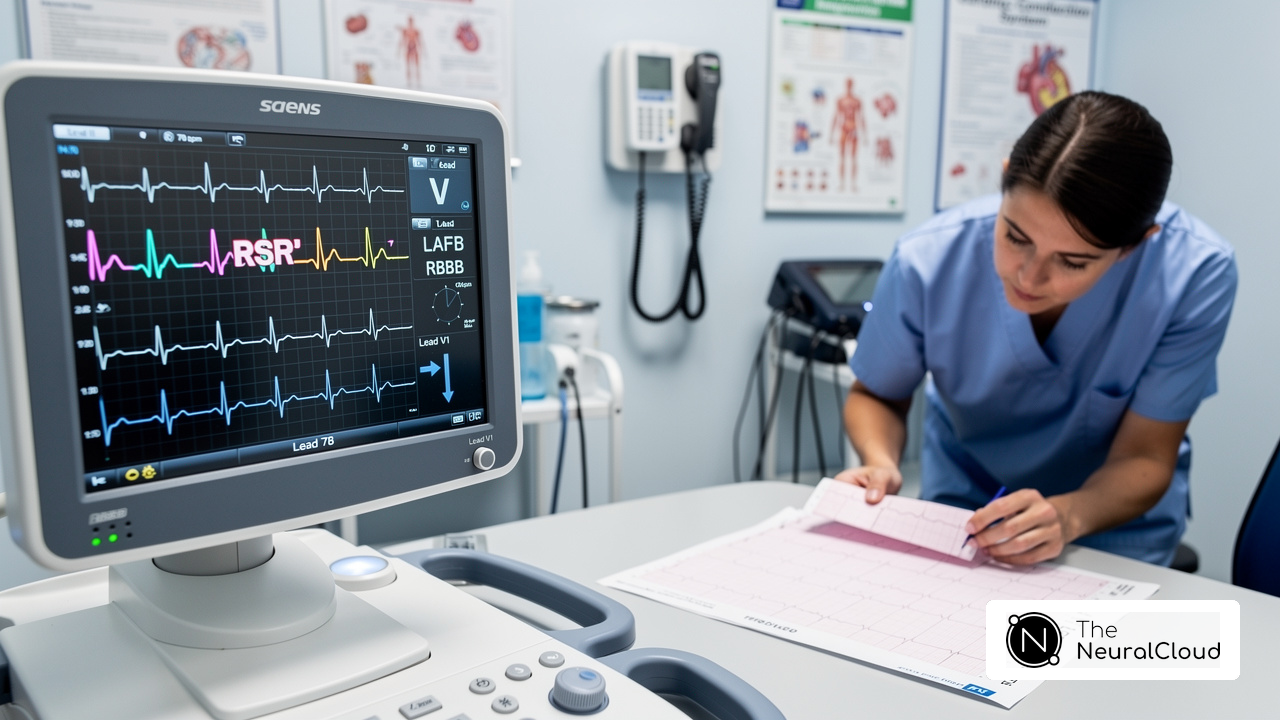
To effectively manage atrial fibrillation, it is essential to understand what does an afib ecg look like, as it presents unique challenges in ECG analysis that demand precise identification. Key features include:
- Irregularly Irregular Rhythm: The ventricular response is unpredictable, with varying intervals between beats, making it a hallmark of atrial fibrillation.
- Absence of P Waves: Unlike normal sinus rhythm, atrial fibrillation is characterized by the absence of distinct P waves, indicating ineffective atrial contraction.
- Fibrillatory Waves: These small, erratic waves may appear between QRS complexes, reflecting chaotic atrial activity.
- Variable Ventricular Rate: The ventricular rate can fluctuate significantly, typically ranging from 100 to 175 beats per minute.
For healthcare professionals, recognizing what does an afib ecg look like is vital for effective patient care, as prompt detection of atrial fibrillation can lead to appropriate treatment measures. The 2023 ACC/AHA/ACCP/HRS Guideline updates emphasize the importance of recognizing these patterns to enhance outcomes for individuals, especially considering the rising occurrence of atrial fibrillation, which impacts almost 38 million people worldwide and is projected to double in the next 35 years.
Neural Cloud Solutions' MaxYield™ revolutionizes this process by automating ECG analysis, mapping signals through noise, and delivering beat-by-beat insights in under five minutes, analyzing up to 200,000 heartbeats rapidly. This advanced AI-driven platform not only identifies key features of atrial fibrillation but also assists healthcare professionals in making confident clinical decisions. Understanding these ECG patterns, especially what does an afib ecg look like, aided by MaxYield™, informs treatment strategies for patients at risk for complications such as heart failure. Furthermore, the AMALFI study, which emphasizes active monitoring for asymptomatic atrial fibrillation, underscores the current importance of identifying atrial fibrillation patterns in clinical practice. Recognizing these ECG characteristics, such as what does an afib ecg look like, is not just beneficial; it is crucial for improving patient outcomes in a landscape where atrial fibrillation is on the rise.

Discuss Clinical Implications of AFib Detection on ECG
Detecting atrial fibrillation on an ECG presents significant challenges that can impact patient outcomes. Early identification allows for prompt interventions, significantly reducing the risk of stroke and severe complications. For instance, patients diagnosed with atrial fibrillation often require anticoagulation therapy to mitigate thromboembolic events, especially if they present additional risk factors such as hypertension or diabetes. The Heartline Study emphasizes this, showing that smartwatches with ECG features can accelerate atrial fibrillation diagnosis, resulting in better cardiovascular outcomes. In this study, participants using smartwatches experienced a fourfold increase in heart arrhythmia detection, with over half showing no prior symptoms. This underscores the potential for early intervention.
Understanding the traits of atrial fibrillation allows healthcare professionals to customize management strategies efficiently. This includes making informed choices regarding rate or rhythm control and essential lifestyle adjustments. Regular monitoring of individuals with AFib is crucial for evaluating treatment efficacy and making timely adjustments to therapies. This proactive approach improves individual outcomes and supports the integration of advanced technologies, such as Neural Cloud Solutions' MaxYield™ platform, into clinical workflows.
By employing Gold Standard Methodologies, MaxYield™ rapidly labels P, QRS, and T Wave onsets and offsets, streamlining workflows and improving diagnostic accuracy. By automating repetitive tasks and processing more data in less time, MaxYield™ enhances ECG analysis efficiency. This supports the discovery of new digital biomarkers, ultimately leading to better patient care. Integrating MaxYield™ into clinical practice not only streamlines ECG analysis but also significantly enhances patient care and outcomes.

Explore Causes and Risk Factors of Atrial Fibrillation
Atrial fibrillation (AFib) presents significant challenges for healthcare providers due to its multifactorial nature. AFib can be triggered by a variety of factors, including:
- Structural Heart Disease: Conditions such as heart failure, valvular heart disease, and congenital heart defects significantly predispose individuals to atrial fibrillation. These structural changes can disrupt normal electrical conduction in the heart, elevating the likelihood of arrhythmias.
- Hypertension: Persistent elevated blood pressure is the primary adjustable factor for atrial fibrillation, impacting more than 70% of atrial fibrillation patients. It results in structural alterations in the heart, such as left ventricular hypertrophy, which can further worsen the likelihood of developing atrial fibrillation. A combined estimate shows that hypertensive individuals have a 73% higher chance of developing AF compared to those without hypertension.
- Lifestyle Factors: Changeable contributing elements such as obesity, excessive alcohol intake, and smoking are associated with a higher chance of atrial fibrillation. For example, being overweight or obese can increase the chance, but losing just 10% of body weight may assist in lowering this chance. Furthermore, smoking is linked to a greater chance of atrial fibrillation, highlighting the significance of lifestyle changes.
- Age: The risk of atrial fibrillation increases with age, particularly in individuals over 65, with approximately one-third of people in this age group affected by the condition. As life expectancy grows, the occurrence of atrial fibrillation is anticipated to increase, requiring proactive screening and management strategies.
- Comorbid Conditions: Conditions such as diabetes, hyperthyroidism, and obstructive sleep apnea are linked to a greater occurrence of atrial fibrillation. For instance, unmanaged sleep apnea can exacerbate atrial fibrillation symptoms, emphasizing the significance of thorough evaluations of individuals.
Recognizing these risk factors not only aids in prevention but also enhances the overall management of atrial fibrillation, ultimately benefiting patient care. Furthermore, initiatives like the AF-B-STEP project aim to enhance the diagnosis and treatment of AF, linking AF burden to significant health outcomes.

Conclusion
Understanding atrial fibrillation's characteristics on an ECG is essential for effective cardiac care. This article highlights the significance of recognizing AFib's unique ECG features, such as:
- An irregularly irregular rhythm
- Absence of P waves
- Presence of fibrillatory waves
These indicators play a crucial role in spotting AFib early, allowing healthcare providers to implement timely interventions that can significantly reduce the risks associated with this condition.
Key insights discussed include the role of advanced technologies like Neural Cloud Solutions' MaxYield™ platform in enhancing ECG analysis. By automating the identification of AFib patterns and streamlining the diagnostic process, this technology empowers healthcare professionals to make informed clinical decisions swiftly. Additionally, the article emphasizes the multifactorial nature of AFib, detailing various risk factors, including:
- Hypertension
- Lifestyle choices
- Age
These factors contribute to its prevalence and impact on patient health.
In conclusion, recognizing the ECG features of atrial fibrillation is not merely an academic exercise; it is a vital component of improving patient outcomes. With the global rise of AFib, healthcare providers must leverage advanced tools and strategies to ensure early detection and effective management. By adopting these technologies, they can transform their approach to AFib management, ultimately leading to better cardiovascular health and reduced complications for individuals affected by this common arrhythmia.
Frequently Asked Questions
What is atrial fibrillation?
Atrial fibrillation is a condition characterized by an irregular and often rapid heartbeat, resulting from disorganized electrical signals in the atria, which leads to ineffective atrial contractions.
Why is atrial fibrillation clinically important?
Atrial fibrillation is clinically important because it significantly increases the risk of stroke, heart failure, and other cardiovascular complications.
How does atrial fibrillation affect pulse?
Atrial fibrillation leads to an irregularly irregular pulse, which is a key indicator of the condition.
What technology does Neural Cloud Solutions use to improve ECG analysis for atrial fibrillation?
Neural Cloud Solutions uses the MaxYield™ platform, which enhances ECG analysis efficiency through advanced noise filtering and automation of critical waveform labeling.
How does the MaxYield™ platform assist healthcare professionals?
The MaxYield™ platform helps healthcare professionals by isolating ECG signals from noise and artifacts, improving diagnostic accuracy, and providing actionable insights for patient care.
List of Sources
- Define Atrial Fibrillation and Its Clinical Importance
- Atrial Fibrillation (AFib) Awareness and Stroke Risk - Bristol Myers Squibb (https://bms.com/life-and-science/news-and-perspectives/atrial-fibrillation-afib-awareness-and-stroke-risk.html)
- Atrial fibrillation estimated to affect about 1 in 22 Americans (https://nhlbi.nih.gov/news/2024/atrial-fibrillation-estimated-affect-about-1-22-americans)
- Screening-detected atrial fibrillation linked to threefold heart failure risk (https://news-medical.net/news/20260413/Screening-detected-atrial-fibrillation-linked-to-threefold-heart-failure-risk.aspx)
- Boston Scientific Presents Two Late-Breaking Trials at ACC 2026 Highlighting New Evidence in Stroke Prevention for AFib and Treatment of Intermediate-Risk Pulmonary Embolism (https://hmpgloballearningnetwork.com/site/cathlab/news/boston-scientific-presents-two-late-breaking-trials-acc-2026-highlighting-new)
- New Survey Reveals People with Atrial Fibrillation Prioritize Stroke Risk Reduction, Seek More Education on Treatment Options (https://innovationsincrm.com/latest-news/1391-people-with-atrial-fibrillation-prioritize-stroke-risk-reduction)
- Identify Key ECG Features of Atrial Fibrillation
- Patient-Led Smartwatch ECG Follow Up Post AFib Ablation - American College of Cardiology (https://acc.org/latest-in-cardiology/journal-scans/2026/02/02/20/04/patient-led-smartwatch-ecg)
- New ACC/AHA Guideline Focuses on Diagnosis, Management of AFib - American College of Cardiology (https://acc.org/latest-in-cardiology/articles/2023/11/29/18/58/new-acc-aha-guideline-focuses-on-diagnosis-management-of-afib-gl-af)
- Remote atrial fibrillation screening using an ECG patch demonstrates modest benefits (https://escardio.org/news/press/press-releases/Remote-atrial-fibrillation-screening-using-an-ECG-patch-demonstrates-modest-benefits)
- Screening-detected atrial fibrillation linked to threefold heart failure risk (https://news-medical.net/news/20260413/Screening-detected-atrial-fibrillation-linked-to-threefold-heart-failure-risk.aspx)
- Atrial Fibrillation (https://litfl.com/atrial-fibrillation-ecg-library)
- Discuss Clinical Implications of AFib Detection on ECG
- Smartwatch-Based Screening Improves Detection of New-Onset A-Fib (https://thecardiologyadvisor.com/news/smartwatch-based-screening-improves-detection-of-new-onset-a-fib)
- Smartwatches Help Detect Hidden Dangerous Heart Rhythm Problems, Clinical Trial Finds (https://usnews.com/news/health-news/articles/2026-01-23/smartwatches-help-detect-hidden-dangerous-heart-rhythm-problems-clinical-trial-finds)
- Does Early Detection of Atrial Fibrillation Reduce the Risk of Thromboembolic Events? Rationale and Design of the Heartline Study - Center For Body Computing (https://cbc.ict.usc.edu/publication/does-early-detection-of-atrial-fibrillation-reduce-the-risk-of-thromboembolic-events-rationale-and-design-of-the-heartline-study)
- Studies Show Heart Failure is Common in Patients with Afib Detected During Screening (https://dicardiology.com/content/studies-show-heart-failure-common-patients-afib-detected-during-screening)
- EQUAL: Smartwatch Monitoring Improves AFib Detection - American College of Cardiology (https://acc.org/latest-in-cardiology/journal-scans/2026/01/28/02/51/equal)
- Explore Causes and Risk Factors of Atrial Fibrillation
- Combination of hypertension and atrial fibrillation is a ticking time bomb – experts call for simultaneous screening (https://eurekalert.org/news-releases/1078454)
- Who Is at Risk for Atrial Fibrillation? (https://heart.org/en/health-topics/atrial-fibrillation/who-is-at-risk-for-atrial-fibrillation-af-or-afib)
- AF-B-STEP: A global effort to transform atrial fibrillation detection and treatment (https://escardio.org/news/press/press-releases/AF-B-STEP_2026)
- Hypertension and Atrial Fibrillation: A Frontier Review From the AF-SCREEN International Collaboration | Circulation (https://ahajournals.org/doi/10.1161/CIRCULATIONAHA.124.071047)