Introduction
Accurate heart monitoring plays a vital role in modern cardiology. However, traditional ECG methods often capture only brief moments of cardiac activity, which can limit their effectiveness. This is where the Holter monitor comes into play. This portable device offers continuous insights into heart rhythms, allowing for the identification of patterns that are crucial for diagnosing arrhythmias.
Yet, the success of this technology largely depends on the proper setup and interpretation of its leads. Many healthcare professionals face challenges in this area, which can hinder the full potential of Holter monitors. So, how can clinicians ensure they are maximizing the benefits of these devices to improve patient outcomes?
Define Holter Monitors and Their Purpose
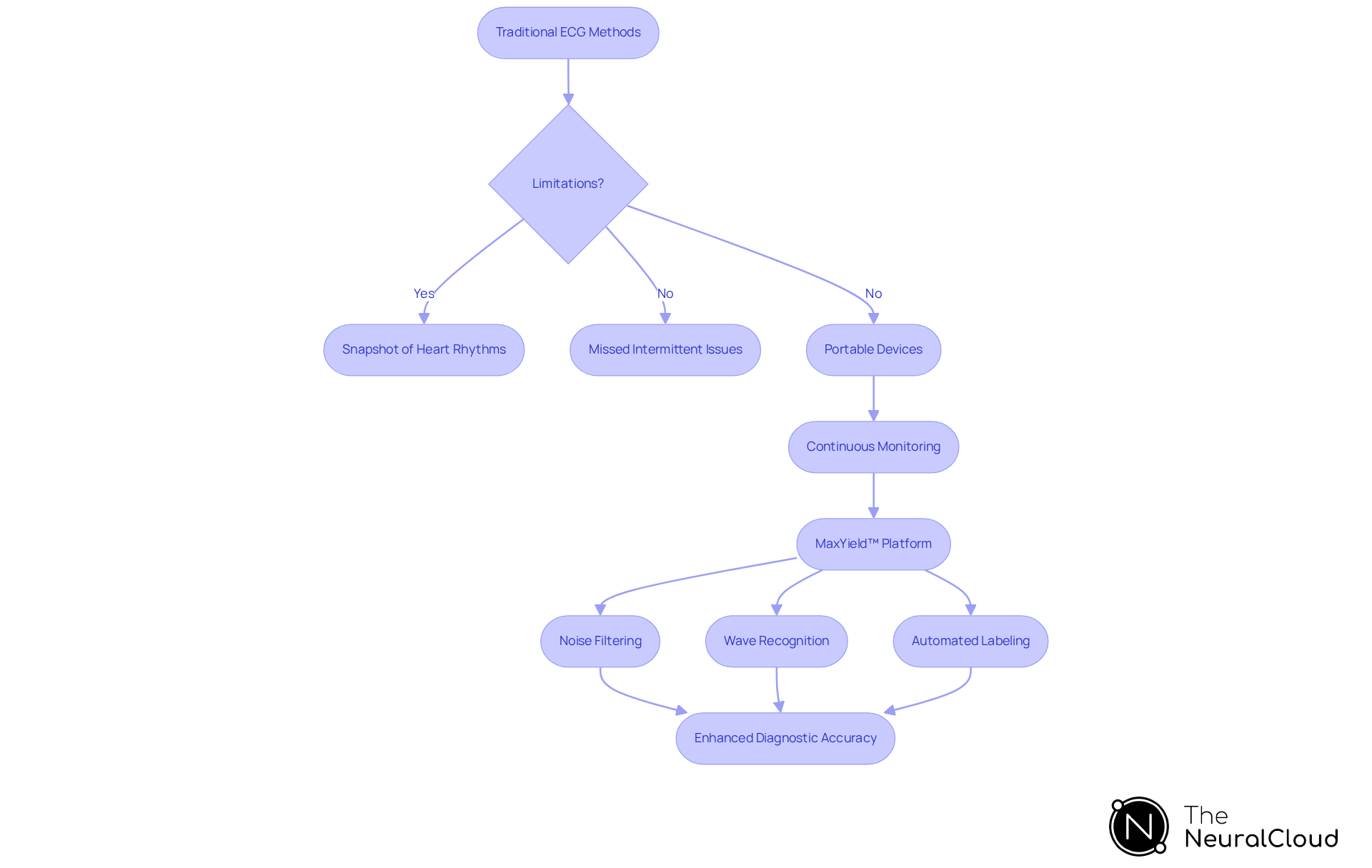
faces several challenges, particularly in accurately capturing and interpreting heart activity. Traditional methods often provide only a snapshot of heart rhythms, which can miss intermittent issues. This is where portable devices come into play, offering technology that reveals patterns over time. Such comprehensive data is crucial for diagnosing arrhythmias and assessing heart function effectively.
The solution from Neural Cloud Solutions addresses these challenges head-on. It features advanced noise filtering and distinct wave recognition capabilities, which enhance the functionality of heart monitoring devices. By isolating artifacts from recordings affected by baseline wander, movement, and muscle artifacts, MaxYield™ ensures that critical data is accurately identified and labeled. This innovative approach not only improves data quality but also streamlines the process for healthcare professionals.
The advantages of using MaxYield™ are significant. For instance, it allows for automated analysis, reducing the time and effort required for manual analysis. Additionally, the platform can process 200,000 heartbeats in under 5 minutes, providing beat-by-beat analysis that enhances diagnostic accuracy. This efficiency is particularly beneficial in clinical settings, where timely and precise information is essential for patient care.
In summary, the MaxYield™ platform represents a significant advancement in cardiac monitoring. By combining technology with sophisticated analysis tools, it empowers healthcare professionals to make informed decisions based on comprehensive data. As the use of portable devices for heart monitoring continues to grow, solutions like MaxYield™ will play a pivotal role in modern cardiology.
Explore the Functionality of Holter Monitor Leads
are designed to capture the heart's electrical signals through multiple connections, commonly configured as 3-wire, 5-wire, and 12-wire systems. Each configuration corresponds to specific lead placements, enabling comprehensive monitoring of heart activity. For instance, a 3-wire system employs three modified bipolar wires arranged in an equilateral triangle, which provides lateral and inferior views of the heart's wall. In contrast, a 12-wire system offers a more detailed analysis of cardiac function.
Proper positioning of the holter monitor lead conductors is crucial for accurate readings and minimizing interference from external factors. Misplacement can lead to artifacts that obscure true ECG signals, potentially compromising diagnostic accuracy. According to cardiology specialists, the choice of lead configuration significantly influences the outcomes of continuous monitoring, as it directly affects the quality of the recorded information.
Case studies have shown that the use of wireless devices enhances ECG recordings by reducing motion artifacts, which in turn improves signal clarity. For example, one study highlighted how devices equipped with multiple ECG channels capture a greater number of waveforms, leading to improved detection capabilities for arrhythmias. This underscores the importance of proper lead placement in enhancing the performance of heart rhythm devices and ensuring reliable cardiac evaluations.
Guide to Setting Up and Using Holter Monitors
- Preparation: Before setting up the Holter monitor, ensure the patient has bathed and is dressed in loose-fitting clothing. This facilitates comfort and enhances comfort during monitoring.
- Lead Attachment: Attach the lead to the patient's skin following the specified wiring arrangement. For a standard 3-lead setup with a lead, position the electrodes on the right arm, left arm, and left leg. Clean and dry the skin beforehand to ensure optimal adhesion and signal quality.
- Connecting Wires: Securely attach the wires to the electrodes, checking for any loose connections that could compromise signal quality. Proper connections are essential to avoid inaccuracies in the recorded data.
- Device Activation: Turn on the Holter device and confirm that it is recording correctly. Monitor the display for any error messages or alerts related to lead placement or signal quality, addressing any issues immediately.
- Patient Instructions: Provide clear guidance to the patient on wearing the device, emphasizing the necessity of keeping it on continuously, including during sleep. Encourage them to maintain a detailed diary of activities and any symptoms experienced throughout the monitoring period. This documentation is vital for correlating their experiences with the collected data, enhancing the overall interpretation, especially when leveraging Neural Cloud Solutions' technology, which evolves with each use to improve accuracy and efficiency in monitoring.
Patients may experience discomfort from electrode sites or forget to document symptoms. To mitigate these issues, stress the importance of following instructions and offer tips for comfort, such as wearing breathable clothing and avoiding excessive movement that could dislodge the electrodes.
Health tech developers recommend using simple language and visual aids to enhance understanding. Offering a checklist of dos and don’ts, such as avoiding showers and keeping the screen dry, can significantly enhance patient adherence to monitoring protocols.

Interpret Holter Monitor Data and ECG Waveforms
Interpreting data from a portable device involves a systematic analysis of recorded ECG waveforms to identify abnormalities. This process can be challenging, but the technology offers a solution that significantly improves accuracy. Here’s an effective approach:
- Establishing the baseline rhythm is crucial as it serves as a reference for detecting deviations. MaxYield™ supports this by providing detailed insights through its analytics, ensuring clarity in baseline identification.
- Recognizing irregularities such as premature ventricular contractions (PVCs), atrial fibrillation, and bradycardia is essential. Each condition displays unique patterns on the ECG, making it important to familiarize oneself with these characteristics. MaxYield™'s advanced noise filtering and wave recognition capabilities enable accurate identification of these arrhythmias, even in recordings with high levels of noise and artifact.
- Cross-referencing recorded data with the patient's symptom diary can reveal correlations between symptoms and specific ECG findings. This practice helps identify triggers for arrhythmias, further supported by MaxYield™'s ability to salvage previously obscured sections of lengthy recordings.
- Utilizing software tools to quantify metrics such as heart rate variability and the frequency of arrhythmias is vital. MaxYield™ enhances this process through its automated labeling and analysis, streamlining the workflow for health tech developers.
- Compiling the analysis into a comprehensive report summarizing significant arrhythmias, heart rate trends, and recommendations for further evaluation or treatment is crucial. The efficiency of this reporting is amplified by the continuous learning model of MaxYield™, which improves diagnostic yield and accuracy over time, enabling healthcare professionals to make confident clinical decisions.
By following these steps, clinicians can effectively analyze ECG waveforms from leads, leading to improved identification of arrhythmias and better patient outcomes.

Conclusion
Advancements in Holter monitoring technology, particularly through the MaxYield™ platform, significantly enhance the ability to capture and interpret cardiac data. Continuous monitoring provides a comprehensive view of heart rhythms, effectively addressing the limitations of traditional ECG methods. By utilizing sophisticated analysis tools, healthcare professionals can make more informed decisions, ultimately improving patient outcomes.
The article emphasizes the importance of proper lead setup and data interpretation. Key steps include:
- Ensuring accurate electrode placement
- Understanding the functionality of different lead configurations
- Utilizing automated analysis to identify arrhythmias effectively
Each of these components plays a crucial role in maximizing the diagnostic potential of Holter monitors.
As the field of cardiology evolves, embracing innovative solutions like MaxYield™ is essential for advancing patient care. By prioritizing meticulous setup procedures and leveraging technology for data interpretation, healthcare providers can enhance the accuracy of diagnostics and ensure better management of cardiac conditions. The integration of such tools not only streamlines the monitoring process but also empowers clinicians to deliver timely and effective treatment.
Frequently Asked Questions
What is a Holter monitor and what is its purpose?
A Holter monitor is a portable device that provides continuous monitoring of heart activity, capturing and interpreting ECG data over time to identify patterns and diagnose arrhythmias.
What challenges does traditional ECG analysis face?
Traditional ECG methods often only provide a snapshot of heart rhythms, which can miss intermittent issues, making it difficult to accurately capture and interpret heart activity.
How does the MaxYield™ platform improve ECG analysis?
The MaxYield™ platform enhances ECG analysis through advanced noise filtering and distinct wave recognition capabilities, allowing for accurate identification and labeling of critical data despite interference from baseline wander, movement, and muscle artifacts.
What are the advantages of using the MaxYield™ platform?
The MaxYield™ platform offers automated labeling of ECG data, significantly reducing the time and effort required for manual analysis, and can process 200,000 heartbeats in under 5 minutes, improving diagnostic accuracy.
Why is timely and precise information important in clinical settings?
Timely and precise information is essential for patient care, as it enables healthcare professionals to make informed decisions quickly based on comprehensive cardiac data.
How does the use of portable devices like MaxYield™ impact modern cardiology?
The use of portable devices for arrhythmia detection, such as MaxYield™, represents a significant advancement in cardiac monitoring technology, empowering healthcare professionals to provide better patient care through comprehensive data analysis.
List of Sources
- Define Holter Monitors and Their Purpose
- Comparison of Arrhythmia Detection by 24-Hour Holter and 14-Day Continuous Electrocardiography Patch Monitoring - PMC (https://pmc.ncbi.nlm.nih.gov/articles/PMC7220965)
- theheartclinics.com (https://theheartclinics.com/post/5-major-benefits-of-holter-monitoring)
- globenewswire.com (https://globenewswire.com/news-release/2025/11/21/3192822/0/en/Cardiac-Arrhythmia-Monitoring-Devices-Market-Size-Worth-USD-15-01-Bn-by-2034.html)
- sciencedirect.com (https://sciencedirect.com/science/article/abs/pii/S0735675725002451)
- ecg-od.com (https://ecg-od.com/case-studies)
- Explore the Functionality of Holter Monitor Leads
- linkedin.com (https://linkedin.com/pulse/holter-monitoring-understanding-lead-configuration-setups-banirian-8wkue)
- int.livhospital.com (https://int.livhospital.com/how-many-leads-does-a-holter-monitor-have)
- lifesignals.com (https://lifesignals.com/this-is-the-future-of-cardiac-holter-monitoring-and-diagnostics)
- ecg-od.com (https://ecg-od.com/case_studies/bradford-district-care-foundation-use-of-ecg-on-demands-ai-assisted-12-lead-ecg-interpretation-service)
- Guide to Setting Up and Using Holter Monitors
- sciencedirect.com (https://sciencedirect.com/science/article/abs/pii/S0735675725002451)
- medparkhospital.com (https://medparkhospital.com/en-US/disease-and-treatment/holter-monitor)
- Interpret Holter Monitor Data and ECG Waveforms
- sciencedirect.com (https://sciencedirect.com/science/article/abs/pii/S0735675725002451)
- geekymedics.com (https://geekymedics.com/ecg-case-studies)
- pmc.ncbi.nlm.nih.gov (https://pmc.ncbi.nlm.nih.gov/articles/PMC10264726)
- ecg-od.com (https://ecg-od.com/case-studies)