Introduction
Muscle artifacts in ECG recordings can obscure critical insights into a patient's heart health, often arising from involuntary movements or physiological disturbances. These artifacts present significant challenges for clinicians striving to deliver accurate diagnoses and improve patient outcomes. Understanding the nuances of these interferences is essential for effective ECG analysis.
The MaxYield™ platform offers advanced algorithms designed to minimize muscle artifacts, enhancing the clarity of ECG interpretations. By employing innovative solutions, this platform not only addresses the challenges posed by muscle artifacts but also streamlines the diagnostic process. Healthcare professionals can leverage these features to achieve more precise readings, ultimately benefiting patient care.
Incorporating the MaxYield™ platform into clinical practice provides several advantages. It empowers healthcare providers to enhance diagnostic accuracy, reduce the time spent on interpretation, and improve overall patient outcomes. With its user-friendly interface and robust capabilities, MaxYield™ stands out as a valuable tool in the quest for diagnostic precision.
Understand Muscle Artifacts in ECG Recordings
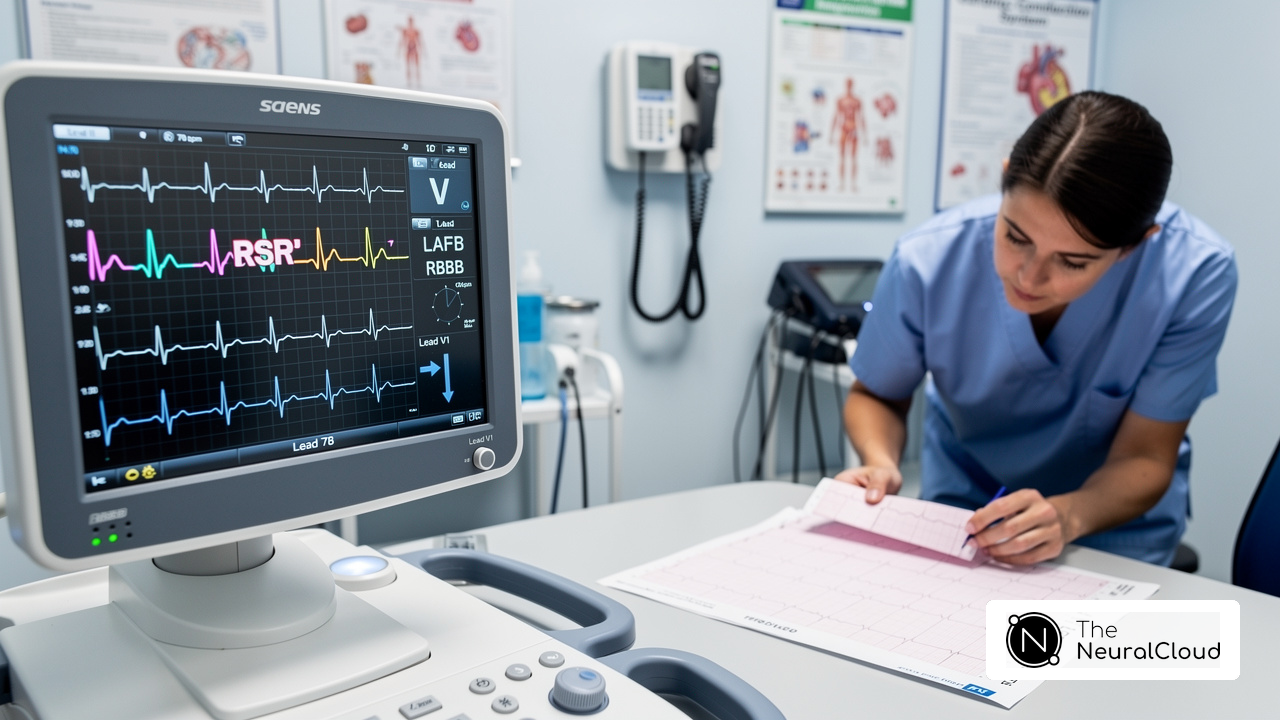
Tissue disturbances in ECG recordings can obscure the heart's true electrical activity, often due to muscle artifact from involuntary contractions. These disturbances may arise from various sources, such as individual movement, shivering, or anxiety. Understanding these features is essential for clinicians to differentiate between genuine cardiac signals and interference. For instance, physiological irregularities typically appear as uneven spikes or oscillations on the ECG trace, often linked to the patient's physical condition. By recognizing these patterns, healthcare professionals can take steps to minimize their impact on ECG interpretation.
Neural Cloud Solutions' MaxYield™ platform addresses these challenges effectively. It employs advanced algorithms that identify and label critical data, even amidst high levels of noise and artifacts. A study presented at the European Heart Rhythm Association Congress in 2026 highlighted that false-positive alerts in implantable cardiac monitors frequently stem from misclassified benign rhythms due to body movement interference. Dr. Federico Nani noted, "This straightforward, user-friendly AI-driven method exhibited enhanced precision in recognizing and excluding occlusive myocardial infarction in individuals lacking ST elevation compared to traditional diagnostic routes." By utilizing MaxYield™, healthcare professionals can significantly reduce interference from muscle artifact and recover previously hidden segments of extensive Holter, 1-Lead, and patch monitor recordings, thereby improving the accuracy of ECG interpretations.
To mitigate the effects of physiological disturbances, clinicians can implement several strategies:
- Optimizing individual positioning
- Ensuring appropriate electrode placement
- Utilizing advanced filtering methods like those offered by MaxYield™
Additionally, specific case studies have shown that integrating AI-driven solutions can greatly enhance the identification and categorization of tissue anomalies, leading to improved patient outcomes.
Key Features of MaxYield™:
- Advanced algorithms for noise reduction
- Enhanced precision in ECG interpretation
- User-friendly interface for healthcare professionals
Advantages for Healthcare Professionals:
- Improved diagnostic confidence
- Streamlined clinical workflows
- More reliable evaluations of patients
In summary, the MaxYield™ platform not only enhances the accuracy of ECG analysis but also supports healthcare professionals in delivering better patient care.

Implement Advanced Algorithms for Artifact Reduction
ECG analysis often faces challenges due to muscle artifact, which can obscure the clarity of recordings. Advanced algorithms, particularly those utilizing artificial intelligence and machine learning, play a vital role in addressing these issues. Techniques such as adaptive filtering, wavelet transforms, and deep learning models are designed to effectively isolate and eliminate noise from ECG signals.
Adaptive filtering, for instance, dynamically adjusts to the noise characteristics in real-time, allowing for continuous reduction of disturbances. This capability not only enhances the clarity of ECG signals but also significantly improves diagnostic accuracy. By integrating these sophisticated algorithms into their ECG analysis workflows, healthcare providers can ensure high-quality cardiac assessments.
The benefits of employing these advanced technologies are substantial. They not only streamline the analysis process but also enhance outcomes for individuals by providing clearer and more accurate readings. As healthcare professionals seek to improve their diagnostic capabilities, embracing these innovations is essential for delivering optimal patient care.

Integrate Best Practices into Healthcare Systems
To effectively tackle the challenges in ECG analysis, healthcare systems must adopt a comprehensive strategy that encompasses training, protocol development, and technology integration. Healthcare professionals need to be trained on the latest techniques for minimizing discrepancies, including optimal positioning of patients and precise electrode placement. Additionally, healthcare facilities should establish standardized protocols that incorporate advanced algorithms aimed at reducing discrepancies.
The MaxYield™ platform from Neural Cloud Solutions offers several key features that significantly enhance the ECG analysis process. It rapidly labels P, QRS, and T Wave onsets and offsets, facilitating quick and accurate interpretation of cardiac signals. Moreover, the development of neural network models for complex signal processing improves the extraction of essential features from recorded signals, providing actionable insights and aiding in the identification of new digital biomarkers.
With its advanced noise filtering and automation capabilities, MaxYield™ empowers healthcare systems to process larger volumes of data in less time. This addresses inefficiencies and physiological variability in ECG analysis, ultimately leading to improved diagnostic quality. By fostering a culture of continuous improvement and adherence to best practices, healthcare systems can significantly enhance the quality of ECG diagnostics.
In summary, the MaxYield™ platform not only streamlines the ECG analysis process but also supports healthcare professionals in delivering more accurate and timely diagnoses. Its integration into healthcare systems represents a significant advancement in the field, ensuring that both technical and non-technical audiences can appreciate its benefits.

Embrace Continuous Improvement in ECG Analysis
Advancements in ECG analysis present significant challenges that impact diagnostic accuracy and patient outcomes. To address these challenges, healthcare professionals must prioritize ongoing education and training. Staying updated with the latest research and technological advancements in techniques for reducing muscle artifact is essential. Engaging in workshops, webinars, and collaborative research initiatives not only enhances individual knowledge but also fosters a culture of innovation within clinical teams.
The MaxYield™ platform offers features designed to improve ECG analysis significantly. By leveraging advanced algorithms, it enhances the accuracy of ECG interpretations, thereby reducing the likelihood of muscle artifacts that can lead to misdiagnosis. This improvement translates into better patient outcomes, as clinicians can make more informed decisions based on reliable data.
Moreover, utilizing feedback from ECG interpretations allows for continuous refinement of processes. This iterative approach not only improves the accuracy of future analyses but also empowers healthcare providers to deliver the highest quality of care in cardiac diagnostics. By adopting a mindset of continuous improvement, clinicians can ensure that they are equipped with the best tools and knowledge available, ultimately benefiting both themselves and their patients.

Conclusion
Mastering the reduction of muscle artifacts in ECG recordings is essential for improving the clarity and accuracy of cardiac assessments. Healthcare professionals face challenges in ensuring that the heart's true electrical activity is accurately represented and interpreted. By employing advanced technologies and best practices, they can significantly enhance diagnostic outcomes.
The MaxYield™ platform offers several key features that address these challenges:
- It optimizes patient positioning and electrode placement.
- It utilizes cutting-edge algorithms.
- These features help in identifying and minimizing muscle artifacts.
- They streamline the ECG analysis process.
As a result, healthcare professionals can achieve more reliable evaluations and improved patient care.
Moreover, the integration of AI-driven solutions within the MaxYield™ platform empowers clinicians to tackle challenges associated with muscle interference. This fosters a culture of continuous improvement within healthcare systems, ultimately benefiting patients through enhanced diagnostic accuracy and care.
In conclusion, the commitment to implementing these best practices and embracing technological advancements is crucial for delivering high-quality cardiac diagnostics. By prioritizing ongoing education and adopting innovative tools like the MaxYield™ platform, healthcare professionals can ensure they are equipped to meet the evolving demands of ECG analysis, leading to better outcomes for patients.
Frequently Asked Questions
What are muscle artifacts in ECG recordings?
Muscle artifacts in ECG recordings are disturbances caused by involuntary muscle contractions, which can obscure the heart's true electrical activity. These artifacts may arise from individual movement, shivering, or anxiety.
Why is it important for clinicians to understand muscle artifacts?
Understanding muscle artifacts is essential for clinicians to differentiate between genuine cardiac signals and interference, allowing for more accurate ECG interpretation.
How do physiological irregularities appear on an ECG trace?
Physiological irregularities typically appear as uneven spikes or oscillations on the ECG trace, often linked to the patient's physical condition.
What solutions does the MaxYield™ platform provide for muscle artifacts?
The MaxYield™ platform employs advanced algorithms that identify and label critical data amidst high levels of noise and artifacts, significantly reducing interference from muscle artifacts.
What was highlighted in the study presented at the European Heart Rhythm Association Congress in 2026?
The study highlighted that false-positive alerts in implantable cardiac monitors often stem from misclassified benign rhythms due to body movement interference, and that the MaxYield™ platform improves precision in recognizing and excluding occlusive myocardial infarction.
What strategies can clinicians implement to mitigate physiological disturbances in ECG recordings?
Clinicians can optimize individual positioning, ensure appropriate electrode placement, and utilize advanced filtering methods like those offered by MaxYield™.
What are the key features of the MaxYield™ platform?
Key features of MaxYield™ include advanced algorithms for noise reduction, enhanced precision in ECG interpretation, and a user-friendly interface for healthcare professionals.
What advantages does MaxYield™ offer to healthcare professionals?
MaxYield™ provides improved diagnostic confidence, streamlined clinical workflows, and more reliable evaluations of patients.
How does the MaxYield™ platform support better patient care?
By enhancing the accuracy of ECG analysis and reducing the impact of muscle artifacts, the MaxYield™ platform supports healthcare professionals in delivering better patient care.
List of Sources
- Understand Muscle Artifacts in ECG Recordings
- EHRA 2026 Studies Reveal Why False Positives Persist in AI-Equipped Implantable Cardiac Monitors (https://globenewswire.com/news-release/2026/04/14/3273285/0/en/EHRA-2026-Studies-Reveal-Why-False-Positives-Persist-in-AI-Equipped-Implantable-Cardiac-Monitors.html)
- Muscle Artifact Removal in Single-Channel Electrocardiograms using Temporal Convolutional Networks (https://ui.adsabs.harvard.edu/abs/2022embc.conf..414B/abstract)
- Automatic identification of movement and muscle artifacts in ECG based on statistical and nonlinear measures (https://ui.adsabs.harvard.edu/abs/2024metr.conf...51O/abstract)
- AI-based ECG interpretation outperforms standard diagnosis of occlusive myocardial infarction (https://news-medical.net/news/20260323/AI-based-ECG-interpretation-outperforms-standard-diagnosis-of-occlusive-myocardial-infarction.aspx)
- Investigating the Generalizability of ECG Noise Detection Across Diverse Data Sources and Noise Types (https://arxiv.org/html/2502.14522v1)
- Implement Advanced Algorithms for Artifact Reduction
- AI-Based ECG Analysis Significantly Improves STEMI Detection, Reduces False Activations - American College of Cardiology (https://acc.org/latest-in-cardiology/articles/2025/10/24/16/56/tues-554pm-ai-tct-2025)
- Artificial intelligence in ECG diagnostics - where are we now? (https://escardio.org/communities/councils/cardiology-practice/education/cardiopractice/artificial-intelligence-in-ecg-diagnostics-where-are-we-now)
- New study finds AI model improves heart attack detection (https://health.ucdavis.edu/news/headlines/new-study-finds-ai-model-improves-heart-attack-detection/2025/11)
- powerfulmedical.com (https://powerfulmedical.com/blog/how-is-ai-transforming-ecg-interpretation)
- Integrate Best Practices into Healthcare Systems
- modmed.com (https://modmed.com/resources/blog/12-best-quotes-on-the-future-of-healthcare)
- A comparison of methods to suppress electrocardiographic artifacts in local field potential recordings (https://sciencedirect.com/science/article/pii/S1388245722009488)
- Motion Artifact Reduction in Electrocardiogram Signals Through a Redundant Denoising Independent Component Analysis Method for Wearable Health Care Monitoring Systems: Algorithm Development and Validation (https://medinform.jmir.org/2022/11/e40826)
- Reduction of Motion Artifacts In Electrocardiogram Monitoring Using an Optical Sensor | Biomedical Instrumentation & Technology (https://array.aami.org/doi/full/10.2345/0899-8205-45.2.155)
- AI-Enabled ECG Reduces Mortality: Breakthrough in Medical AI (https://healthmanagement.org/c/hospital/news/ai-enabled-ecg-reduces-mortality-breakthrough-in-medical-ai)
- Embrace Continuous Improvement in ECG Analysis
- New study finds AI model improves heart attack detection (https://health.ucdavis.edu/news/headlines/new-study-finds-ai-model-improves-heart-attack-detection/2025/11)
- AI-Based ECG Analysis Significantly Improves STEMI Detection, Reduces False Activations - American College of Cardiology (https://acc.org/latest-in-cardiology/articles/2025/10/24/16/56/tues-554pm-ai-tct-2025)
- AI-Powered ECG Analysis Promising for Early Detection of COPD - Drugs.com MedNews (https://drugs.com/news/ai-powered-ecg-analysis-promising-early-detection-copd-128342.html)
- AI-Powered ECG Analysis Offers Promising Path for Early Detection of Chronic Obstructive Pulmonary Disease, Say Mount Sinai Researchers (https://mountsinai.org/about/newsroom/2026/ai-powered-ecg-analysis-offers-promising-path-for-early-detection-of-chronic-obstructive-pulmonary-disease-say-mount-sinai-researchers)
- Breakthrough in heart health: A new approach to interpreting ECG data using large language models (https://eurekalert.org/news-releases/1073406)